What Is OCD?


You check the door once. Then again. Then one more time, just to be sure. You know the door is locked, but leaving without checking again doesn’t feel right. It’s one of the examples I use most often when I’m explaining OCD to a patient’s family, because almost everyone can picture it, even if they’ve never lived it.
Medical Disclaimer
This article is provided for general educational and informational purposes only and does not constitute medical advice, diagnosis, or treatment. While the content is written with input from a licensed healthcare professional, reading this article does not create a nurse-patient, provider-patient, or any other professional relationship between you and the author or Vida Atlas.
The information here is general in nature and is not a substitute for personalized medical advice from your own doctor or qualified healthcare provider, who can take your full medical history and individual circumstances into account. Always consult your doctor or another qualified healthcare provider with any questions you may have regarding a medical condition, and never disregard professional medical advice or delay seeking it because of something you read on this site.
If you think you may have a medical emergency, call your local emergency number or go to the nearest emergency room immediately. Do not rely on this article for urgent or emergency medical situations.
Vida Atlas and the author make no representations or warranties about the accuracy, completeness, or timeliness of the information provided, and disclaim liability for any actions taken or not taken based on the content of this article.
Quick Answer
OCD (obsessive-compulsive disorder) is a condition that involves unwanted thoughts, fears, urges, or doubts called obsessions, along with repetitive behaviors or mental rituals called compulsions.
Obsessions and compulsions often occur together, but not always. Some people struggle mostly with obsessions, while others notice compulsions or mental rituals more than the thoughts themselves. The specific theme can shift over time too, so someone might spend a period focused on contamination fears and later notice a different obsession taking its place.
What OCD Can Feel Like
Everyone experiences unwanted thoughts from time to time. With OCD, the problem is not simply having the thought. The problem is feeling driven to do something in response to it. Obsessions can focus on many different topics, including:
- Contamination or germs
- Harm coming to yourself or others
- Making a mistake
- Safety concerns
- Religious or moral fears
- Relationships
- Health concerns
A person with OCD may know that the fear doesn’t fully make sense, but that doesn’t make it any easier to ignore. That insight, the awareness that a fear is likely irrational, is actually one of the things that makes OCD so exhausting, since the thoughts don’t stop just because the logical part of the mind disagrees with them.
Why Do Compulsions Happen?
Obsessions create discomfort, uncertainty, or fear. To reduce that feeling, a person may perform a compulsion. This could be checking, cleaning, repeating, counting, seeking reassurance, reviewing memories, or mentally replaying situations. OCD often occurs alongside general anxiety, and it can help to understand what anxiety disorder itself feels like.
The compulsion often provides temporary relief. The specific ritual varies from person to person, but the pattern is usually similar: anxiety rises, a ritual follows, and relief appears for a while. That relief is exactly what keeps the cycle going, since the brain quickly learns to associate the ritual with feeling safer, even though the safety is only ever temporary.
OCD Isn’t Always Visible
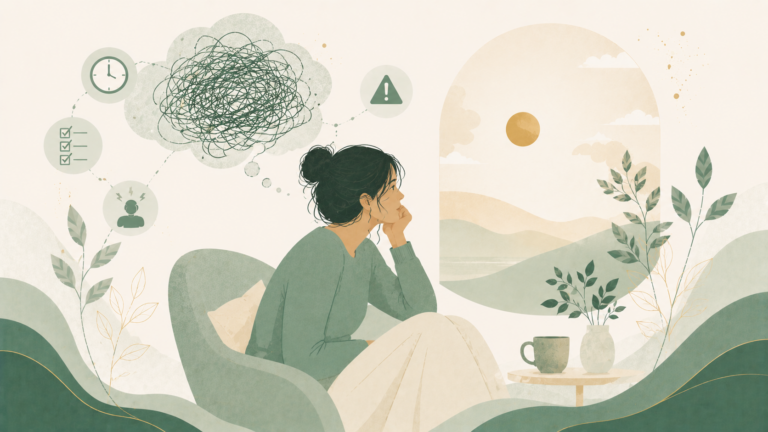
OCD is not always something other people can see. Some compulsions happen entirely inside the mind. A person may spend hours analyzing thoughts, replaying conversations, seeking reassurance, or trying to convince themselves that a feared outcome will not happen.
Because these rituals are often invisible, OCD can be misunderstood or overlooked for a long time. In my experience, this is one of the most under-recognized parts of it: a person can look completely calm on the outside while running an exhausting mental loop no one else can see.
What May Help
One challenge with OCD is that behaviors that bring short-term relief can keep the cycle going over time. Treatment can help break the pattern of fear, rituals, and temporary relief. Therapy can be very helpful, and some people also benefit from medication.
Exposure and response prevention (ERP), which gradually involves facing fears without performing the usual compulsion, is one of the main therapies used for OCD. The goal isn’t to eliminate every unwanted thought, but to reduce the control those thoughts and rituals have over everyday life.
When It Becomes More Than a Personality Trait
Being organized, liking routines, or preferring things done a certain way does not automatically mean someone has OCD. OCD becomes a problem when obsessions and compulsions take up a lot of time, cause significant stress, or start affecting work, relationships, and everyday life.
Conclusion
At its core, OCD is often less about the ritual itself and more about the need for certainty. In my experience, the difficulty is that complete certainty is something no one can achieve. Recovery often involves becoming more comfortable with not having every answer or guarantee. If you’re trying to distinguish OCD from anxiety, burnout, or other conditions, see my comparison guide.