Diastasis Recti After Birth: What It Is and What Helps

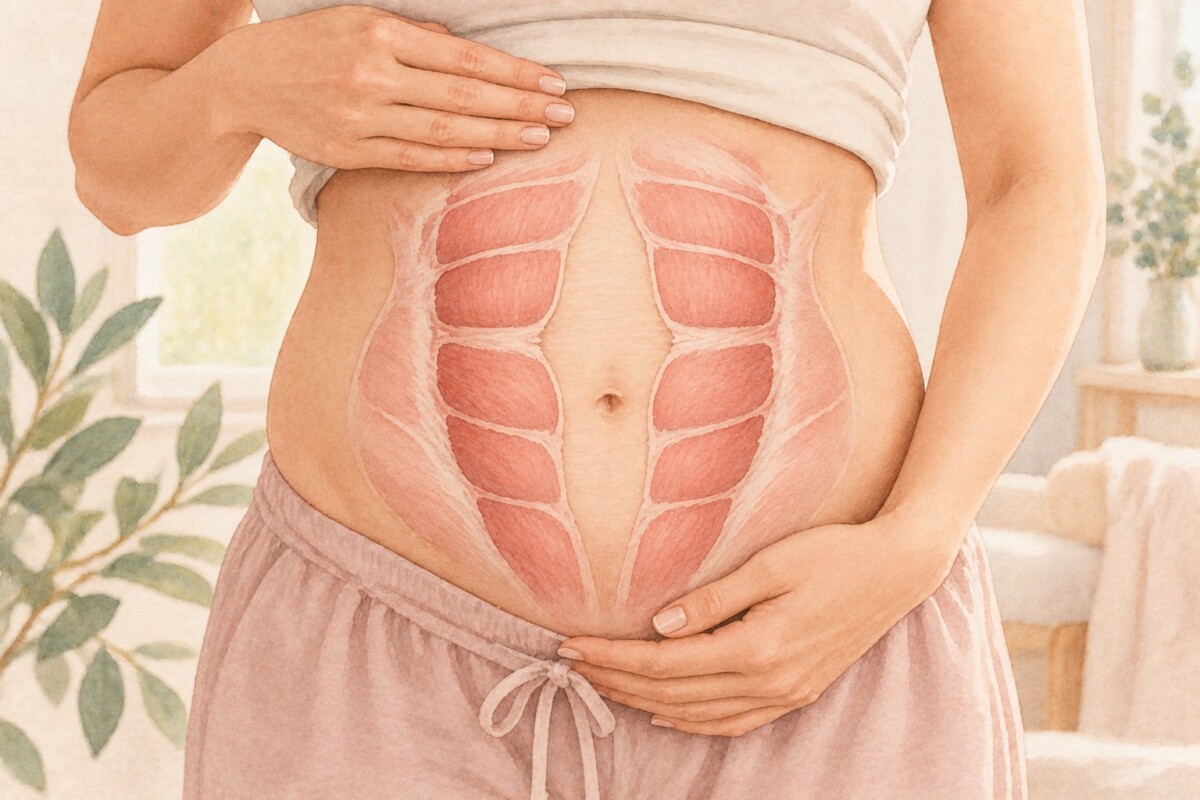
If you’re still looking a little bit pregnant months after giving birth, no matter how much you’ve recovered otherwise, you might be dealing with diastasis recti. It’s extremely common, rarely talked about, and almost never explained clearly.
The good news is that it’s very treatable in most cases, once you understand what’s going on and what kind of movement helps.
Medical Disclaimer
This article is provided for general educational and informational purposes only and does not constitute medical advice, diagnosis, or treatment. While the content is written with input from a licensed healthcare professional, reading this article does not create a nurse-patient, provider-patient, or any other professional relationship between you and the author or Vida Atlas.
The information here is general in nature and is not a substitute for personalized medical advice from your own doctor or qualified healthcare provider, who can take your full medical history and individual circumstances into account. Always consult your doctor or another qualified healthcare provider with any questions you may have regarding a medical condition, and never disregard professional medical advice or delay seeking it because of something you read on this site.
If you think you may have a medical emergency, call your local emergency number or go to the nearest emergency room immediately. Do not rely on this article for urgent or emergency medical situations.
Vida Atlas and the author make no representations or warranties about the accuracy, completeness, or timeliness of the information provided, and disclaim liability for any actions taken or not taken based on the content of this article.
Quick Answer
Diastasis recti is a separation of the abdominal muscles that run down the front of your belly, and it affects roughly 6 in 10 women after childbirth. For most women, targeted core exercises meaningfully improve it, though some need physical therapy or, less often, surgery to fully close the gap.
What’s Happening in Your Body?
As your uterus expands during pregnancy, it stretches the connective tissue (the linea alba) that holds your two rectus abdominis, or “six-pack,” muscles together at the center of your belly. This stretching lets the muscles separate to make room for your growing baby.
After birth, that connective tissue usually tightens back up on its own. In some women, though, it stays loose, and the gap between the muscles doesn’t close the way it should, which is what leaves the belly looking softer or slightly rounded even after other postpartum changes have resolved. It’s one of many changes covered in Postpartum Body Changes: What to Expect.
How Is Diastasis Recti Checked?
You may see online instructions for checking the gap between your abdominal muscles with your fingers. This can give you a rough idea of what your abdominal wall feels like, but it is not a complete assessment.
Early postpartum recovery also takes time, so you do not need to start measuring your abdomen immediately after birth. If you are concerned about a persistent gap, bulging, weakness, pain, leaking, pelvic pressure, or returning safely to exercise, a healthcare professional or pelvic health physiotherapist can assess how your abdominal wall and pelvic floor are functioning.
What About Exercise?
There is no single exercise program that is right for every postpartum woman with diastasis recti. Recovery depends on your symptoms, the function of your abdominal wall and pelvic floor, how recently you gave birth, and your previous level of activity.
Rather than following a generic list of exercises to avoid or exercises that promise to “close the gap,” it can be more useful to have a pelvic health physiotherapist assess you and show you how to progress your core exercises safely.
What Can Help
A few general directions tend to be more useful than any single exercise list:
- An assessment from a pelvic health physiotherapist before starting a specific core routine.
- Gentle, guided breathing and deep core activation rather than jumping straight into crunches or intense ab work.
- Good posture and lifting technique when carrying your baby, a car seat, or anything heavy.
- Patience with the timeline. Real improvement is usually measured in months, not weeks.
A Personal Note
I had diastasis recti after my own pregnancy, but that was not the only change to my abdomen. After losing weight, I was also left with significant loose skin that hung over my lower abdomen, along with stretch marks.
In my case, exercise could not remove the excess skin. I eventually chose abdominoplasty with muscle repair, and the abdominal muscle separation was corrected during the same surgery.
I mention this because diastasis recti and loose skin are often talked about as if they are the same problem. They are not. Exercise and physiotherapy can help with abdominal function, but they cannot remove a significant amount of excess skin. Surgery is an option in some cases, not something every woman with diastasis recti will need.
When to See a Doctor or Physical Therapist
Consider asking for a referral if:
- The gap hasn’t noticeably improved by several months postpartum.
- You have ongoing lower back or pelvic pain.
- You notice a visible bulge along your midline, especially with straining or lifting.
- You’re leaking urine or feel pelvic pressure.
- Core weakness is affecting everyday movement, like getting out of bed or picking up your baby.
Conclusion
Diastasis recti is one of many common changes after pregnancy, but the size of the gap alone does not tell you how well your core is functioning. Recovery can look very different from one person to another.
If you have persistent bulging, weakness, pain, pelvic floor symptoms, or you are unsure how to return to exercise, an individual assessment can be more useful than trying to diagnose or treat the problem yourself. And if loose skin is part of what bothers you, remember that it is a separate issue from the muscle separation and may have different treatment options.